Sovereign AI Solutions
For government, healthcare, legal and other regulated organisations whose data cannot be handed to a public AI service. Build, deploy, and operate AI systems within environments you fully control: AppXcess provides the private infrastructure, the models that run on it, and the governance around both.

What Is Sovereign AI
Sovereign AI means running AI inside infrastructure your organisation owns and governs, rather than sending your data to someone else to process. It rests on four things: data sovereignty, infrastructure ownership, privacy, and operational control.

Full Ownership
The servers, the storage and the model weights stay in your custody. Model weights are the trained file holding what a model learned from your data, so where they sit matters.
Data Residency
Sensitive information stays inside the countries and networks you specify, which is usually what a regulator, a public-sector contract or a client agreement actually requires.
Operational Control
You decide when a model is updated, retuned or replaced. On a public AI service a vendor update can change the behaviour of a process you have already validated.
Private LLM
A private LLM is a language model that runs on infrastructure you control and serves your organisation alone. It is the model layer of Sovereign AI: prompts, documents and responses stay inside your environment instead of being sent to a public AI service.
Dedicated Models
Your own instance of an open-weight language model, tuned to your terminology and processes rather than shared with other customers.
Secure Operations
Prompts, retrieved records and response history are handled inside your own network, so the content of a query is not passed to an outside provider.
Controlled Access
Access is granted through your existing identity directory, so the rules that govern your other systems also govern who can use the model.

Private GPT
Private GPT is the assistant your teams use day to day. It sits on top of a private LLM and connects it to your internal documents, so people can ask a question in plain language and get an answer drawn from your own records, with a reference back to the source.

Internal Knowledge
Connect the assistant to internal file shares and databases so answers come from your own documents and point back to the source record.
Context Awareness
Give the assistant the context it needs, such as department, project and role, so responses reflect how your organisation actually works.
Department Intelligence
Configure task-specific assistants for work such as contract review, invoice checking or policy lookup, each scoped to that team.
Local LLM Deployment
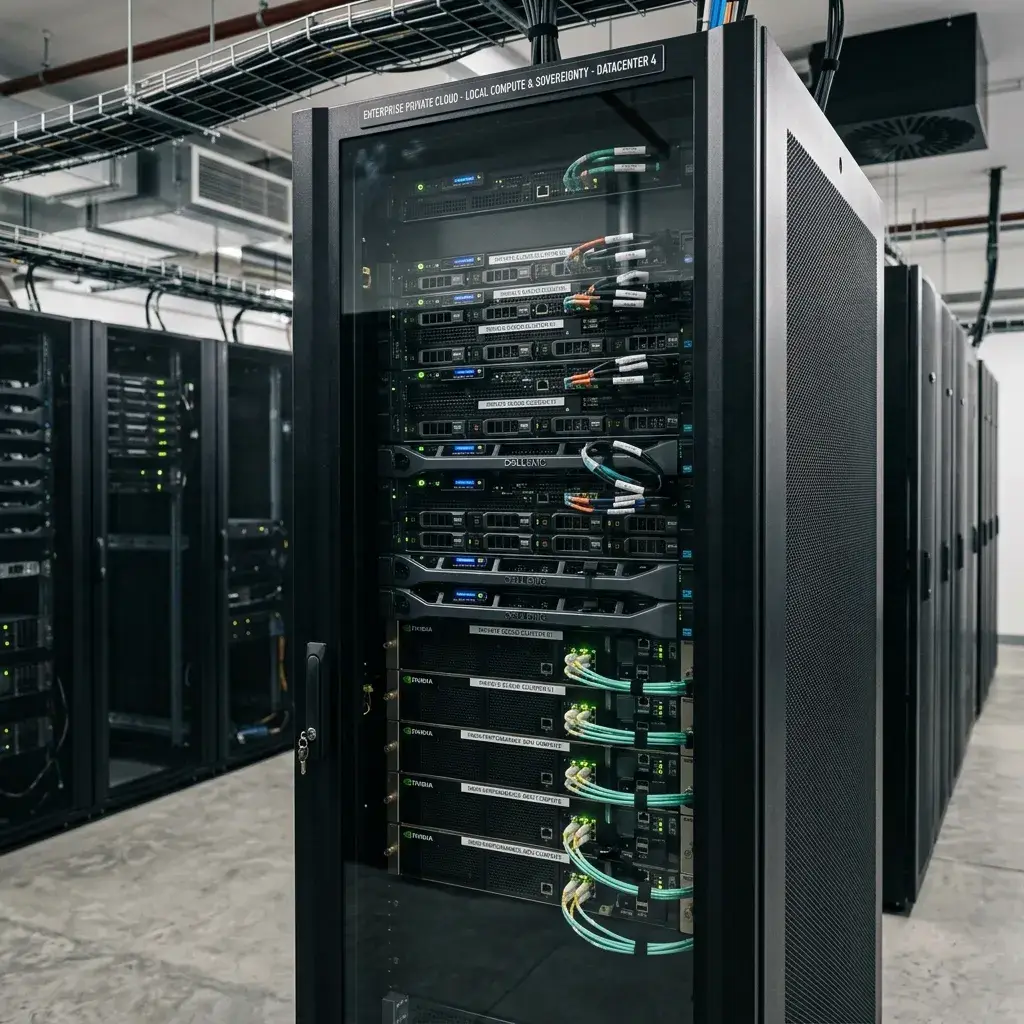
Local LLM deployment is where the model physically runs. The same private model can sit in your own data centre, in a private cloud tenancy, or in an air-gapped network, and that choice is what determines residency, latency and how independent you are of outside services.
On-Prem Hosting
Host open-weight models such as Llama or Mistral on your own GPU servers, with no inbound path from the public internet.
Internal Processing
Inference and document search run inside your network, so prompts and the records they retrieve do not leave it.
Infrastructure Independence
Services keep running on your own hardware if an external provider has an outage or your connectivity to it drops.
Secure Data Processing
Sensitive records are prepared, indexed and logged inside your environment, so the data an AI system touches stays under your own privacy, retention and governance rules.
Protected Workflows
Personal data, credentials and security codes can be filtered out of text before it ever reaches a model, using components that run inside your own environment.
Secure Documents
Financial records, employee registries and operational files are indexed in isolated storage, so only permitted roles and systems can query them.
Trusted Operations
What was asked, what was retrieved and what the model answered are written to an audit record you hold, so a later review can reconstruct any decision.

Air-Gapped Architecture
An air-gapped environment has no connection to the public internet at all. Data and updates move in and out through a controlled, deliberate process rather than over a network, which is what some government, defence and health workloads require.

Network Isolation
The environment runs with no route to public networks or external domains, so nothing reaches it over the internet.
Controlled Access
Administrative rights are granted through hardware keys and your internal sign-on, so console-level actions are tied to a named person.
Secure Processing
Sensitive content is processed inside the isolated environment, with no dependency on cloud services or external logging.
On-Premise AI
Run AI in your own facilities, with the hardware, the software stack and the data all sitting inside a data centre you own or lease.
Infrastructure
Dedicated servers and GPU capacity installed in your own data centre or server room, sized to the workloads you plan to run.
Local
Processing
Models are loaded and queries answered on site, so prompts and documents are not sent to an outside service to be processed.
Control
Your teams decide the software configuration, the virtualisation layer and how data moves between systems.

Sovereign AI for Government
Public bodies hold citizen data that cannot leave national infrastructure, and procurement rules often rule out sending it to a commercial AI service. Sovereign AI keeps the model, the data and the audit trail inside infrastructure the department controls.
Citizen Services
Answer routine public queries with an assistant that runs on department infrastructure, not a cloud service.
Public Intelligence
Search legislation, planning records and archives inside an isolated environment, with nothing sent outside it.
Secure Operations
Keep a verifiable record of what the system was asked and what it returned, held by the department itself.


Sovereign AI for Healthcare
Patient data is governed by privacy law and cannot be handed to a public AI service. Sovereign AI keeps clinical records, the model that reads them and the access logs inside the health system environment.
Clinical Support
Bring patient history, laboratory results and clinical notes together for care teams, with the processing running on servers the health system controls.
Research Intelligence
Search published literature and internal case files together, without exposing study data or unpublished work to an outside service.
Privacy Controls
Patient registries sit in isolated storage with rules on what may be retrieved, so records are not used to train anyone else's model.
Sovereign AI for Legal Services
Case files, contracts and client communications are privileged. Sending them to a public AI service creates a disclosure risk most firms and in-house teams will not accept, so Sovereign AI keeps both the documents and the model inside the practice.
Contract Intelligence
Review contracts, regulatory agreements and compliance briefs with a model that runs inside your own environment.
Legal Research
Search precedent, statute and your own matter history through an index held locally, so a query does not reveal what you are working on.
Compliance Review
Check documents and operations against the policies and regulations you configure, keeping a record of what was checked.

Compliance & Governance
AppXcess does not certify your organisation and does not issue compliance status. What Sovereign AI provides are the controls, records and boundaries your own compliance programme depends on: policy rules you define, monitoring you can see, and logs you hold when an auditor asks.
Policy Controls
Set the rules a model works under, covering what it may answer, what it must refuse and which sources it can draw on, and enforce them in your environment.
Risk Management
Watch for changes in model behaviour, unexpected retrievals and mismatched records, and flag them to a named owner for review.
Audit Readiness
Produce the activity and configuration history an audit asks for, from records kept in your environment rather than in a vendor system you cannot query.

Sovereign AI Architecture
How a sovereign AI environment is assembled, stage by stage: infrastructure, private models, knowledge, secure processing, governance, compliance, and enterprise adoption.
Dedicated Enclave Cluster
Dedicated bare-metal servers, GPU capacity and private networking, separated from shared multi-tenant cloud infrastructure.
Hardware-level boundaries, dedicated GPU nodes, isolated virtualisation layers.
You control where the infrastructure sits and who can reach it.
Workloads do not share hardware with other organisations.

Sovereign AI FAQs
Sovereign AI means running AI inside infrastructure your organisation owns and governs instead of sending your data to a public AI service. It covers four things: data sovereignty (your data stays where you decide), infrastructure ownership (the servers and model weights are yours), privacy (prompts and documents are not shared with an outside provider) and operational control (you decide when models change).
They are three layers of the same system. A private LLM is the model itself, dedicated to your organisation. A private GPT is the assistant built on that model and connected to your internal documents, so teams can ask questions and get answers with sources. Local LLM deployment is where the model physically runs, whether that is your own data centre, a private cloud tenancy or an air-gapped network.
Yes. In an air-gapped deployment the environment has no route to public networks, and data, models and updates move in and out through a controlled process rather than over a network. That is the configuration used where connectivity to an outside provider is not permitted at all.
On-premise in your own data centre, in a private or dedicated cloud tenancy, or in an air-gapped environment. The choice sets your data residency, how much of the infrastructure you operate yourself, and how independent the system is of external services. The same private models can run in any of the three.
No. Compliance status and certification are granted by auditors and regulators, not by a technology provider. What a sovereign deployment gives you are the controls and the evidence your own programme relies on: data residency you can point to, access controls tied to your identity systems, policy rules you define, and activity and configuration logs you hold and can export for a review.
Organisations whose data cannot leave their control. On this page that is government bodies handling citizen data, healthcare providers handling patient records, and legal teams handling privileged material — and more generally any regulated organisation whose contracts or regulators restrict where data is processed.
Deploy AI Without Giving Up Control
Tell us where your data has to stay, what you need the AI to do, and the rules you report against. We will show what a sovereign deployment looks like in your environment, on-premise, in a private cloud, or air-gapped.